Mixing & concentration
Identify recirculation patterns, poorly mixed regions and concentration nonuniformity. Evaluate the transport of feeds or tracer substances.
CHO BIOREACTORS · STIRRED-TANK CFD ENGINEERING
Quantify mixing. Compare mechanical exposure. Inform scale-up.
CFD engineering for and related cultures. Examine impeller-driven circulation, oxygen concentration gradients, mixing time and the distribution of mechanical exposure—not just tank-average measurements. Cell-viability prediction is available only through a separate, data-calibrated development scope.
01 / ENGINEERING CHALLENGES
In CHO stirred-tank reactors, bulk readings can conceal local oxygen gradients, delayed mixing and different exposure histories near impellers and recirculation zones. CFD helps identify these spatial differences and compare practical equipment changes.
Identify recirculation patterns, poorly mixed regions and concentration nonuniformity. Evaluate the transport of feeds or tracer substances.
Examine shear-rate distributions, local mechanical conditions and exposure accumulated along material histories.
Explore biological-response models as a separate, data-supported research scope. Quantitative cell-viability claims require calibration and independent validation.
Compare configurations and operating conditions before committing to equipment changes or new production volumes.
02 / HOW WE CAN HELP
For a CHO reactor design or troubleshooting project, the first deliverable is usually a comparison of flow and mixing conditions—not a promised percentage improvement in cell survival.
Defined-scope CFD studies using established OpenFOAM or STAR-CCM+ workflows. Compare mixing and recirculation, spatial oxygen or tracer distribution, shear exposure and operating scenarios where the required models are justified and verified.
See original solver outputsWe can evaluate and adapt cell-population and biological-response models when suitable cell-culture measurements are available. A paid feasibility and calibration stage comes before any quantitative survival prediction or performance guarantee.
What data are neededWhat a first engagement can answer: Where does mixing lag? How do impeller alternatives change circulation? Which regions experience elevated shear? How do operating conditions compare? Predicting a numerical change in viable-cell density requires additional biological evidence.
03 / RESEARCH & MODEL DEVELOPMENT
Our custom solver research extends flow calculations with transported cell populations and a specified biological response. This is an engineering R&D capability, not yet an independently validated predictor of CHO cell survival.
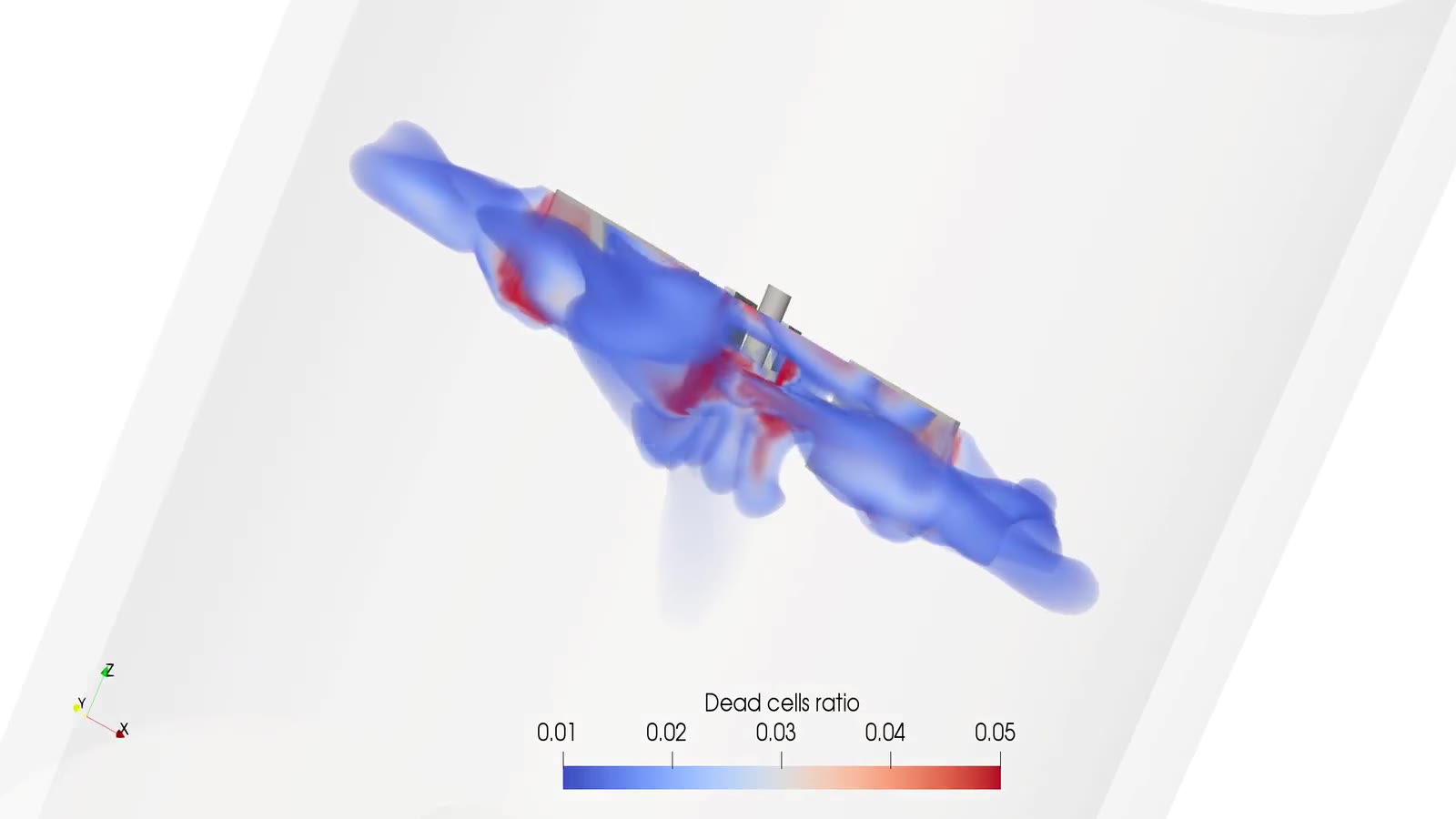
This is an original dead-cell-ratio field from our stirred-tank OpenFOAM research project. The red and blue regions follow the legend in the rendering and represent higher and lower values of the modeled dead-cell fraction around the impellers.
The field is calculated from transported cell-population variables and a prototype biological-response formulation coupled to CFD. It is not a velocity plot, a recording of individual cells, or an experimental measurement. The animated version appears in the hero above.
Model status: This demonstrates coupled CFD and population-transport research, not a validated CHO survival prediction. Quantitative mortality estimates would require verified population balances, cell-line-specific calibration and independent experimental validation. Reactor hydrodynamics and mixing studies can be performed without that biological model.
04 / ORIGINAL CFD RESULTS
These are outputs from our OpenFOAM bioprocess research: a spatial dissolved-oxygen field and two parcel-exposure distributions. They demonstrate the diagnostics behind the engineering service; they are not measurements of a commercial CHO cultivation run.
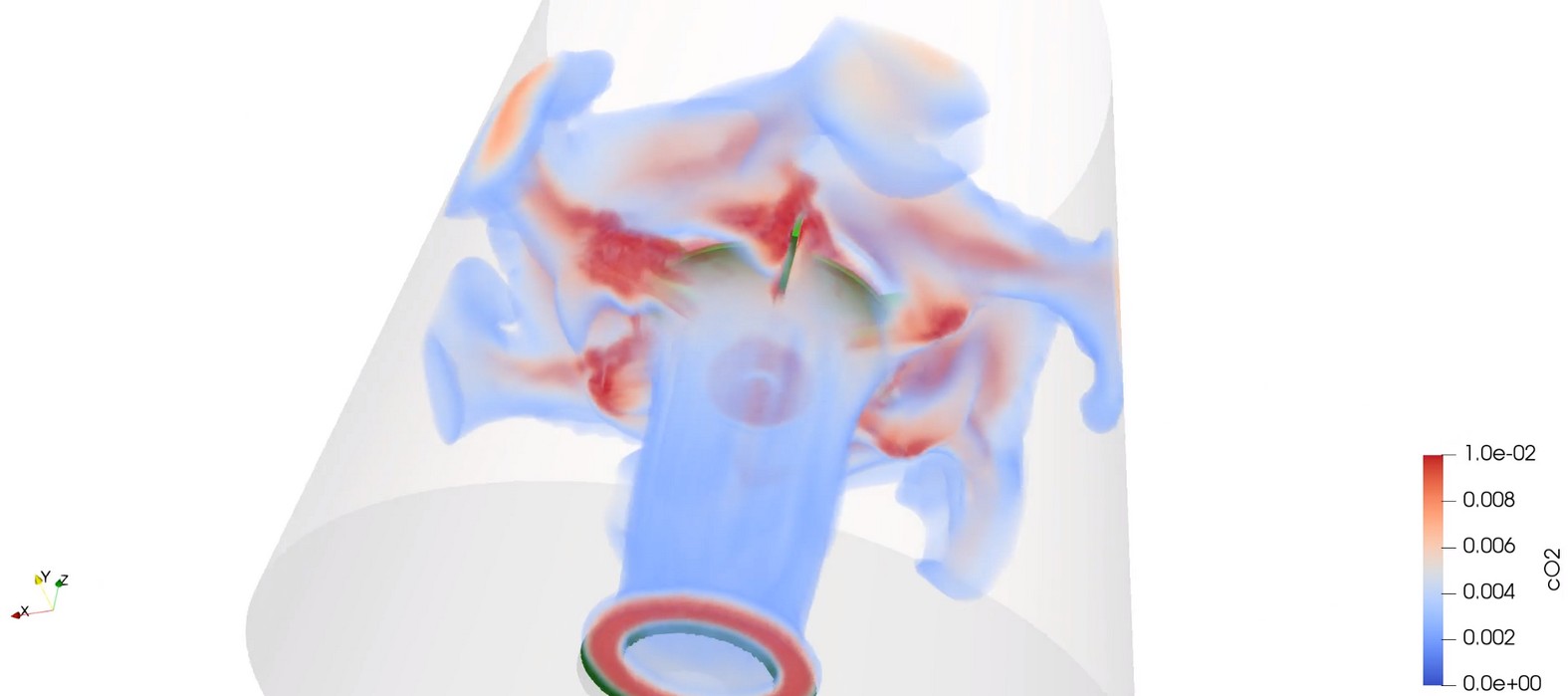
cO2—this means dissolved O₂, not carbon dioxide (CO₂).WHY IT MATTERS TO BIOPROCESS ENGINEERS
Spatial concentration: Locate gradients and recirculation patterns that may be obscured by bulk probe measurements.
Exposure distributions: Distinguish typical conditions from the small population of material parcels that accumulates unusually high exposure.
Operating comparisons: Evaluate the effect of agitation, gas feed and geometry on the simulated environment, with the required models and measurements defined for each project.
See the project data we needLAGRANGIAN DIAGNOSTICS / ORIGINAL SOLVER OUTPUT
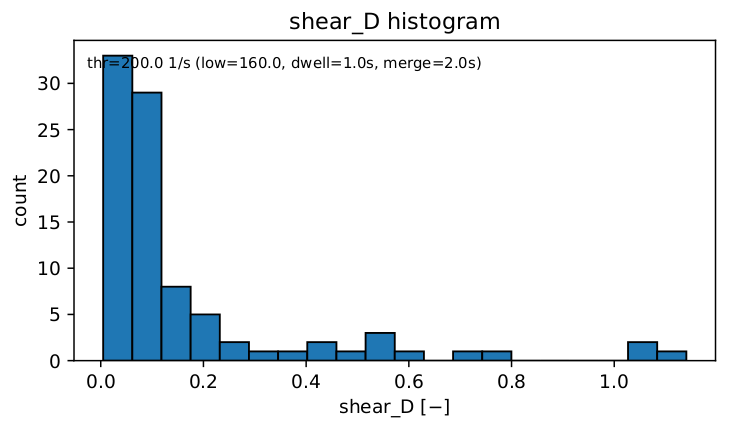
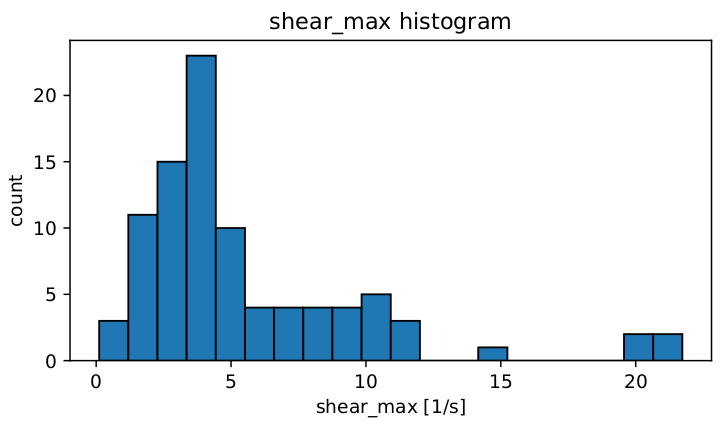
These original histograms summarize histories accumulated by virtual cell-carrying material parcels. They are computed parcel surrogates, not recordings of individual cells or a calibrated probability of cell death.
05 / INTERACTIVE REPORT EXPLORER
Explore the types of distributions a reactor study can report: mixing time, spatial concentration uniformity, circulation, shear exposure and dosing. For original recorded project outputs, see the CFD reference figures above. The interactive example below uses generated chart data, not measurements or exported CFD fields.
Time for a sampled region to remain within ±5% of its final tracer concentration.
Normalized tracer concentration across equal-volume reactor samples at a selected time.
Time between consecutive completed circulation loops for tracked fluid parcels.
Cumulative mechanical exposure index; repeated encounters increase total exposure.
Highest local shear rate encountered by each parcel during the observation period.
Duration above a selected shear threshold for parcels experiencing at least one exceedance.
Integrated dosing exposure normalized to a reference, distinct from instantaneous concentration.
Chart data are generated solely to demonstrate the interactive report. They are not exported CFD results. Mixing, dosing and mechanical-exposure values would be calculated for each commissioned reactor study.
06 / INDUSTRIAL APPLICATIONS
CHO suspension cultures for monoclonal antibodies and recombinant proteins are our primary target. We also support related hydrodynamic engineering questions for HEK293 and Sf9 stirred-tank systems without claiming validated cell-line-specific viability models.
Monoclonal antibodies & therapeutic proteins
Hydrodynamic engineering for CHO stirred-tank cultivation: compare impellers, agitation settings, mixing times and spatial shear exposure. Support equipment selection, process troubleshooting and lab-to-pilot or production-scale hydrodynamic comparisons.
Gene therapy & viral vectors
Investigate mixing, feed distribution and hydrodynamic conditions in suspension-adapted HEK293 reactors used during viral-vector process development.
Vaccines & recombinant proteins
Evaluate stirring strategies, mixing efficiency and exposure conditions in baculovirus-based suspension cultivation, independently of full infection-kinetics prediction.
Hydrodynamic investigations can also support Vero, MSC, iPSC, CAR-T and cultivated-meat reactors where the engineering question is clear. Microcarriers, aggregates and immune-cell function introduce additional physics or biology; their behavior cannot be predicted with our existing CHO-oriented service scope.
07 / ENGINEERING DECISIONS
Compare defined alternatives on the same performance basis: geometry, working volume, mixing criterion and operating conditions. Hydrodynamic improvements do not by themselves demonstrate higher cell viability or product yield.
Compare geometry, placement and multi-impeller arrangements to understand how they change circulation, mixing and local stress.
Assess mixing performance alongside shear exposure and power requirements over a defined operating range.
Investigate changes in local hydrodynamics from laboratory to pilot or production equipment.
Study injection placement, transport and concentration nonuniformity under realistic operating conditions.
08 / DATA & VALIDATION
The required data depend on the decision you need to make. A design-screening CFD study can start without a complete biological dataset; a quantitative CHO viability model cannot.
Ideally, provide reactor CAD or manufacturer drawings covering the vessel, impellers, baffles and sparger (where applicable), plus fill level, RPM, broth properties, gas/feed rates and the conditions to compare.
If available, dissolved-oxygen probe histories, mixing-time measurements, gas holdup, power draw and operating logs make benchmarking and model selection more defensible. We establish input requirements and acceptance criteria before work begins.
Cell-line and culture details, viable/total cell counts over time, viability measurements and cultivation conditions are needed to select a suitable biological model.
Controlled comparisons between operating conditions and data reserved for independent validation are especially valuable. Public datasets may support an initial feasibility study but do not replace reactor-specific evidence.
09 / SCOPE & DELIVERABLES
Results are tied to the agreed design question and documented assumptions. Standard studies report hydrodynamic and mixing performance; cell-survival predictions are excluded unless separately scoped, calibrated and validated.
Discuss the inputs for your caseMixing, circulation & oxygen distribution
Flow structures, spatial concentration gradients and mixing-time or tracer results when required by the scope.
Mechanical exposure distributions
Peak and accumulated exposure statistics, including distribution tails and selected percentile summaries, where tracking is verified for the case.
Operating and scale-up comparisons
Like-for-like assessments of impeller speed, sparging, feed location, geometry, or scale with uncertainties and modeling limitations identified.
Engineering report
Methods, assumptions, limitations, relevant results and actionable recommendations.
START WITH THE ENGINEERING QUESTION
Tell us your CHO reactor model, available CAD or drawings, operating conditions and the engineering decision at stake. We can assess geometry reconstruction if needed, then establish whether the first step is hydrodynamic CFD or biological-model feasibility.